"I just got hit by lightning!"
Sparks jump painfully from my tools to my hands as the telltale buzz of an electrical storm manifests in my inner ears. Ned and I crouch below the chossy ridgeline while CJ violently massages his forehead. We are not welcome here.

© Ned Gall 2010.
Nine hours before, we had set off from the car at four a.m. with ambitions to climb Mount Athabasca by its historic North Face route, one of the first of the great north faces to be climbed in the Canadian Rockies. Athabasca is the Hydro-geographical pinnacle of our continent; Waters north flow to the Arctic Ocean, water flowing east meets the Atlantic Ocean, water moving west joins the Pacific. This point of judgment lies 5,000 vertical feet above us as we tackle the first rock-strewn slopes on the approach. The moon is bright enough to define the mountain's stark and compelling silhouette.
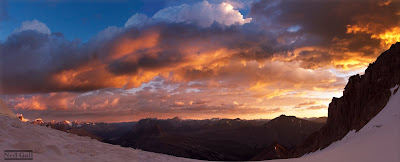
It's only twenty minutes before we reach a cache of gear we left the day before. We sort and divide the equipment by headlamp before simul-soloing the first ice slopes. The toe of the Little A Glacier extends a friendly low-angle ramp, which we use to access the glacier itself. Half an hour of beautiful rambling ice leaves us beneath the Silverhorn and its immense serac just as the moon hides away behind the ridge. We make haste through this exposed zone, crossing crevasses and ascending gentle slopes until we find ourselves below the massive north face. The sun reveals itself and casts the most euphoric golden glow over our surroundings. The photographers in Ned and CJ go haywire while I try to find words to describe the beauty of our position. As the sun begins to climb, we tie in and cross the Bergshrund to gain the lower ice slopes of the North Face.
© Ned Gall 2010.
"Phil, you want to go climbing in Canada?"
One partner shy, Ned Gall invites me to accompany himself and CJ Carter on a climbing and film trip to Northern Alberta. The goal is to climb Mount Athabasca and to put together a video on the importance of glaciers, particularly in climbing. I skip moving into my new abode and throw my pack in the overstuffed trunk.
Two days of driving, eating, hot-springing, and conversing with intoxicated Canadians (even more friendly than standard Canadians) lead us to Banff National Park and the toe of the Athabasca Glacier. This massive flow of glacial ice is only a miniscule protrusion that originates in the Columbia Ice Field. 250 square kilometers in area, the Columbia Ice Field is responsible with providing the vast majority of Western Canada with water for agriculture, drinking, and energy. We spend the rest of the day getting re-acquainted with glacial travel and discussing the grim reality of the future. What happens when the Columbia Ice Field, melting faster every day, is no longer able to satiate the needs of Western Canada? We wave with cynicism to glacier tour busses, hybrid army-tank-schoolbus contraptions capable of driving paying customers onto the glacier. "The more they drive, the more soot and grime coats the ice, the faster it melts," we point out.

© Ned Gall 2010.
The next day exceeds expectations. After a leisurely breakfast, we make our way to the Icefields Visitors Center for coffee and conversation with climbing rangers and curious tourists alike. That afternoon, we begin filming. We return to a Millwell in the ice, a hole created by cascading water, which we had found the day before. Anchors are set up and cameras roll as we take turns lowering into the glacier. Ten meters down and I'm standing in a stream of sub-glacial melt. I realize I am surrounded by a magnificent network of caverns, lit by the most amazing blue hue of light traveling through meters of glacial ice. After a few moments of awe, I begin ice climbing back out of the gaping hole. Soaked by the waterfall and shocked by the lurid beauty of the ice, I grovel over the lip. We take turns all afternoon, lowering, filming, climbing, and simply appreciating the intrinsic splendor of the world we have found. We eat and go to sleep early, getting ready to wake up and climb at 3 a.m..
Athabasca is showing us remarkable hospitality. We find exquisite alpine ice above the bergschrund. Swinging and kicking, we plant our tools and crampons in the perfect glacial ice and work our way upward in rope-length increments. The climbing is endless- every pitch, we stare at the crux rock band, thinking this is the pitch that will take us there. But with very little in the way of landmarks, it is impossible to judge distance on the featureless ice slope, and we clamber on through another thousand feet of thunker sticks. Ice from the leader whizzes past without warning with the sound of bullets. One softball-sized chunk strikes me in the jaw and bursts, another hits Ned in the thigh with a sickening thud. We are happy to be climbing again when we get off the belay.
© Christopher J. Carter 2010.
At last we approach the crux. When the route was first climbed in 1971, ice-climbing pioneer Yvon Chuinard rated this crux 5.4. In the last ten years, badass Canadian alpinist Barry Blanchard re-rated the pitch 5.8. These days, many think it to be 5.9 mixed. It's not that the climbers are getting softer, or that modern equipment fails us in this instance. The ice is simply melting away at an exhaustive rate, revealing more difficult rock every year. "Will this pitch even exist in a climbable form in 20 years?" we wonder.© Christopher J. Carter 2010.
I ask for the lead and after traversing right off the belay I begin up a thin steep ice runnel. After ten meters of the best ice climbing on route, I place my tools on rock, and throw in gear. Tenuous stemming leads to pins in loose chunks. A few more exciting feet of groveling over wild exposure and I find myself placing a tool in good ice yet again. I throw in a screw and head up twenty more meters of ice to the belay. CJ and Ned follow in perfect form, shooting video all the way. CJ takes out the last piece and asks why I didn't place another. I say it makes me feel like Steve House. One more full pitch of 60 degree sugar over ice and I'm on the summit of Athabasca. Ten minutes later and my partners join me for a summit hug. We nurse our late-August screaming barfies and begin down in a torrent of wind and snow.


© Christopher J. Carter 2010.
Bzzzzzzzzzzzz ZAP!
"Get off the ridge!" CJ has just been struck with an electrical discharge, my hands are numb from my sparking tools, and we cower below the ridgeline. With the storm, we cannot continue to the normal descent, consisting of easy rappels. Instead, we opt for a loose and unappetizing scree slope. We stagger our progress and walk on a backwards 45-degree treadmill for a thousand vertical feet. At last on flat ground again, and safe from the hazards of the upper mountain, we skirt the edge of the glacier and begin the final endless plod to the car in pouring rain. At last, 13 hours after we left our vehicle, we are hugging in the downpour and taking haggard self-portraits. We drive back to our wet tents, and away from one of the finest alpine faces I have ever had the honor to climb.

© Christopher J. Carter 2010.
We are driving the other way through the park now, away from the vast glaciers and soaring peaks. How much will the glacier have receded when I return again? Will all the lines we scoped this trip still exist on the next one? Will our children ever come here and be able to experience the thrill that we have? We leave Banff National Park with a newfound respect for the power and importance of glaciers. A reverence gained through interaction and a pure interface is a powerful feeling indeed. I have always found climbing to be an exceedingly pure way to involve yourself in your environment, and to discover what it means to you. But even the bus-goers, glacial-tour trekkers, or even the RV clad families who choose to simply observe from a distance and can't help but be affected by the magnificence of the landscape they find them selves engulfed in. We can only hope that enough people realize this before it is too late.

Stay Tuned! -A short non-fiction film is on its way.


